About us

GATHER IN WORSHIP • GO IN SERVICE
"All Souls Catholic Parish forms disciples of Christ rooted in worship and sent forth to serve all souls."
Our Logo
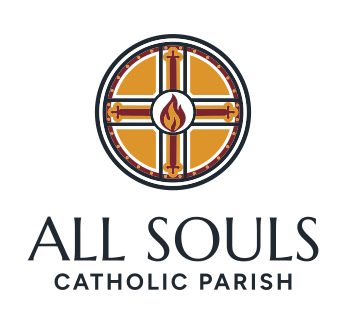
All Souls Catholic Parish is named for the Holy Souls in Purgatory, reflecting our identity as a community rooted in prayer, mercy, and hope. We are a parish that remembers, intercedes, and trusts in God’s promise of eternal life. Our logo was thoughtfully designed to visually express this mission.
The Purgatorial Flame
At the heart of the logo is a flame representing the Holy Souls. It symbolizes both purification and divine love—the fire through which God prepares souls for heaven.
Deep Red and Gold
Red represents sacrificial love, the Holy Spirit, and Christ’s Passion. Gold signifies the glory and light of heaven. Together, they reflect the journey from purification to eternal life.
The Cross & Circular Design
The flame is set within a stained-glass-inspired cross enclosed in a circular form, echoing the rose windows of our church. Together, these elements point to Christ’s saving sacrifice and symbolize eternity, unity, and our call toward Him.
A Visual Mission Statement
More than a design, our logo reflects who we are: a parish devoted to prayer for the faithful departed and to the hope of heaven.
Parish History
Establish July 4, 1887
Catholic life in Sanford, a Seminole County town, dates back to 1882, making it one of the oldest in Catholic history in Central Florida. The All Souls Church that was destroyed by fire in 1931 was built in 1887-1888 by the first missionary of the Diocese of St. Augustine in the area, Father Swembergh. He went to Orlando in 1886 as resident priest and took charge of the four-year-old Central Florida missions in Maitland and Sanford that were begun in 1882 by Father McFaul, a priest from St. Louis, Missouri. He held Mass at Doyle’s Hall, Sanford.
All Souls cornerstone, laid on July 4, 1887, showed that Protestants and Jews had been benefactors of the frame church with its beautiful interior and exterior. It was painted white, had four pillars in front, a gabled roof, and was rectangular in shape. Father Fox of Orlando tended to the Sanford mission until the spring of 1911 when Rev. Patrick J. Bresnahan became the first resident priest. In 1915, Bishop Curley sent Father Bresnahan to Tallahassee where he was able to be influential in combating anti-Catholic state legislation. Father Bresnahan’s ministry was chiefly to non-Catholics for five years after he left All Souls. But Sanford Catholics dated the time when all the sacraments were administered regularly to them from 1911, when Father Bresnahan arrived.
All Souls Catholic Women’s Club was begun in the late 1920’s, and is affiliated with the DCCW. The Holy Name Society, reactivated in 1951, became the Men’s Club. The first school, organized in 1913, closed after one year of operation. Different sources give different dates when the original church burned. It was during the pastorate of Rev. James J. McInerney, who served between September 1, 1930 and August 31, 1932. The church burned on January, 1932, in the midst of Florida’s economic depression and parishioners had to work five years to rebuild a church on the same property. They were poor, but they rebuilt it with their own hands. It cost $28,000, but its value was many times that sum.
Mass was offered, in the interim, in a two-story building Father Bresnahan had built, with the first floor used as chapel and the second as rectory. The new church, of stucco with red tiled roof and tall rectangular windows of colored glass, has a choir loft at the rear. The church seated 430 persons when Bishop Barry dedicated it in 1937, during the pastorate of Rev. John J. Kelleghan.
Rev. William J. Nachtrab, pastor between 1942-1950, rented a house for a rectory and his successor, Rev. Anthony McGowan, bought the rectory at the corner of Oak Street and Eighth Avenue in January, 1951. During the pastorate of Rev. Richard J. Lyons, who was ordained in the Society of the Divine Word, All Souls School once more was established and staffed with the first Sisters of Christian Charity to serve in Florida. Their pupils numbered 165. The school opened on September 7, 1954, in a garage on land purchased by the parish. A hall and permanent school were built in 1960, and in 1981, a multi-purpose center and an addition on the school were built. Sisters of St. Joseph of St. Augustine were on the staff from 1978 to 1983. Laity carried on until the arrival in 1987 of Ursuline nuns. Today, All Soul's Catholic School continues to expand its science and technology labs. The current enrollment is over 300 students.
In addition to the Societies already mentioned, the parish educates an additional 400 students in its Fatih Formation Program. In 1987, there were 750 families at All Souls and today there are over 1,776 families calling All Souls home. Fr. Gilbert Medina was named our pastor in 2014.
All Souls ministries serve the people of the Sanford area – providing tremendous amounts of food, clothing and shelter to those in need, care for the unborn, small children, the elderly and those homebound is a constant concern for the people of All Souls. Healthy and happy married couples caring and loving their children in a nurturing atmosphere is very important to the people of All Souls.
Today, All Souls Catholic Parish is growing faster than ever. The parish has completed the beautiful new church on SR 46. The next phase will be the building of the new school.
You can view a history of our parish complied by parishioner Kim Peters, online here. If you would like to know more about the history of the parish in Central Florida, please visit or call us. We are happy to share our archived timeline of All Souls Catholic Church.
Parish Future
2024 Master Site Plans
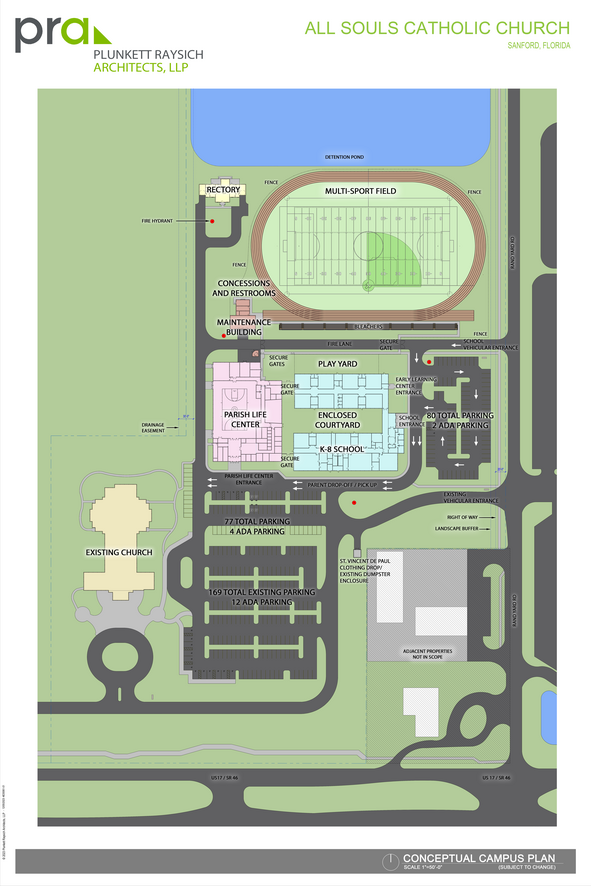
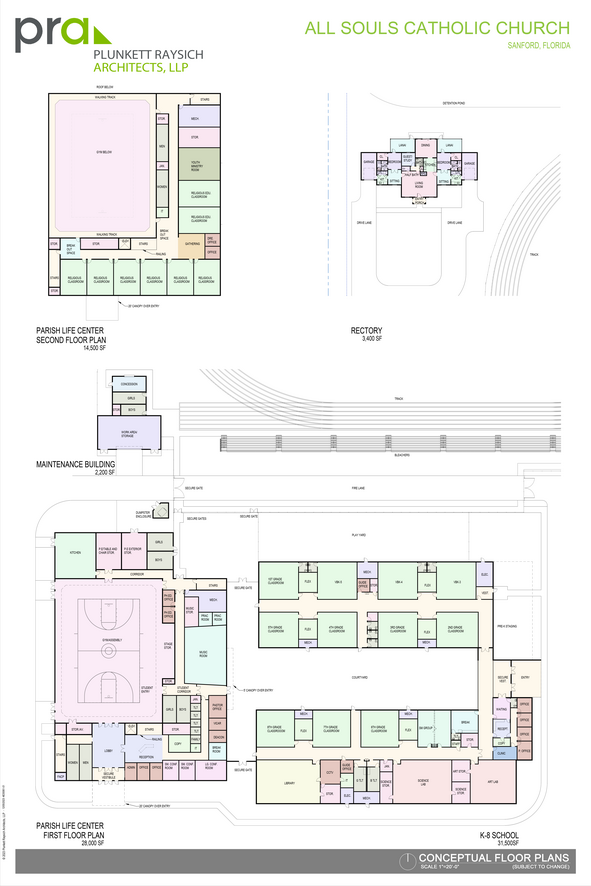
This is the new "Master Plan" for building out our campus on SR 46. During our parish synod, overwhelming support was shared for the construction of a parish hall and parochial school at our new location. Because our property is so limited after the Diocese sold property to CONDEV, Fr. Jeremiah wanted a formal site plan that envisioned all that we would like to see, but made sure that it met all the architectural and civil engineering constraints for our post-sale property size.
What is presented here is the conceptual site plan. Until construction costs come down and the economy improves a bit, we will hold this as our planned dream for the future of our property. As economic issues improve, we will move into discernment of a Capital Campaign to build the Parish Life and Discipleship Center as Phase One of implementing this Site Plan. Thank you for all the positive feedback so far, and we cannot wait to get started!
For any questions, please do not hesitate to contact Fr. Jeremiah or Olman Hernandez, Director of Operations at the Parish Office: (407) 322-3795.